Devam etmek için giriş yapın — işleminiz tamamlanacak. Hesabınız yok mu? Kaydolun
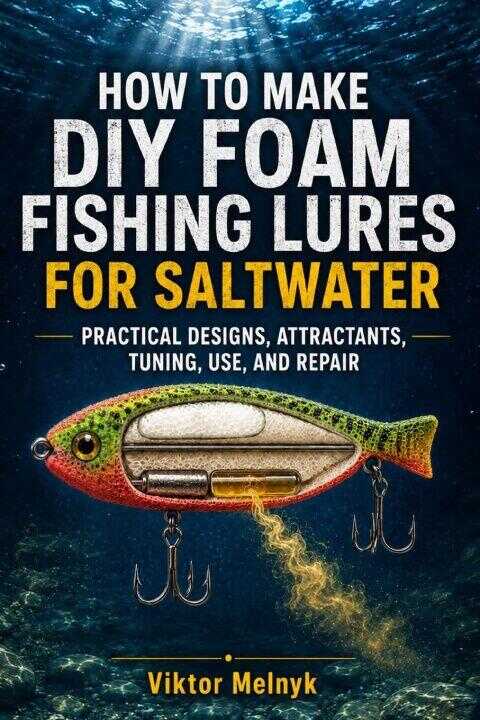
How to Make DIY Foam Fishing Lures for Saltwater.
Açıklama İngilizce dilinde
A porous lure is more than a shaped piece of soft material with a hook. Its performance depends on how the body, internal frame, hook position, weight, buoyant insert, scent system, and reinforced areas work together. This practical guide explains how to make, assemble, test, maintain, and restore foam-based fishing lures intended for use in saltwater. The material is written for beginners but includes enough technical detail to help readers develop their own reliable designs rather than simply copy an external shape. The book explains how open-cell foam absorbs water and holds liquid or thick scent formulations within its pores. It also shows how water saturation changes body weight, buoyancy, balance, and the position of the finished lure. Inside, you will learn how to:• select foam by pore structure, density, flexibility, and strength;• choose body shapes for different loads and working conditions;• build a continuous internal wire frame;• position single, double, or partially concealed hooks;• install fixed or replaceable weights;• use buoyant inserts to control body position;• create internal channels, pockets, chambers, and replaceable capsules;• use porous inserts for gradual scent release;• reinforce the nose, hook area, seams, and other high-stress zones;• test a fully assembled and water-saturated lure;• adjust buoyancy, sinking speed, balance, and weight distribution;• prepare the lure before use and inspect it afterward;• remove salt from pores, channels, and internal cavities;• repair cuts, torn sections, damaged chambers, and deformed bodies;• replace hooks, frames, inserts, and modular bodies;• store dry, assembled, and pre-soaked lures correctly. Special attention is given to the problems created by saltwater. Salt can remain inside the pores after the surface appears dry. Moisture trapped near hooks, loops, rings, or hidden wire sections can increase corrosion risk. Adhesives, coatings, plugs, tubes, and internal inserts must also remain compatible with water and the selected scent formulation. The guide includes several body and internal-system options, from simple one-piece models to reinforced, modular, adjustable-weight, floating, slow-sinking, and capsule-equipped designs. Each construction is considered as a complete system with its own advantages, limitations, maintenance needs, and possible failure points. The central principle is simple: first define the properties the finished lure must have, and only then select the material, shape, frame, hook, weight, buoyancy system, and scent-delivery method. Copying only the outside appearance cannot produce a predictable result. Reliable performance comes from controlling the internal structure, water absorption, load path, balance, scent retention, and access for cleaning and repair.
▾ Devamını oku▴ Daha az
Takasa Açık
0Şu an takasa açan yok.
Takasa çıkınca haber ver