
Melden Sie sich an — wir schließen die Aktion für Sie ab. Kein Konto? Registrieren
Electrical Protection and Fault Safety in Factories
Beschreibung auf Englisch
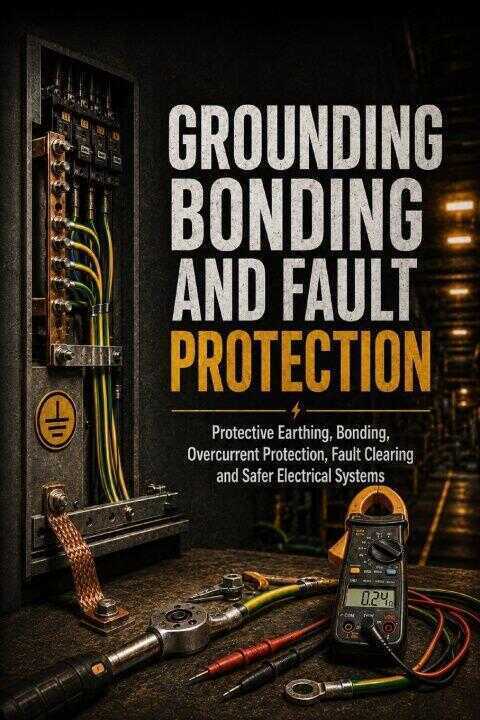
LECTRICAL PROTECTION AND FAULT SAFETY IN FACTORIESEarthing, Bonding, RCDs, Overcurrent Protection, Arc Faults, Selectivity and Fire PreventionA protective device does not make a factory circuit safe simply because it is installed. Safety depends on the complete fault path: where current flows, whether the fault can be detected, how quickly energy is interrupted, and whether conductors, enclosures and exposed metal remain safe until clearance.In real factories, protection failures are rarely simple. A healthy breaker may be too slow for the measured loop impedance. An RCD may trip repeatedly because of cumulative leakage from VFDs and filters. A machine frame may remain energized because a protective conductor is broken, corroded or poorly bonded. A transformer, generator, UPS or retrofit may change fault current and silently invalidate settings that once worked.ELECTRICAL PROTECTION AND FAULT SAFETY IN FACTORIES is a practical, manufacturer-neutral engineering guide to protective design, fault-current paths, interruption, coordination and fire prevention in industrial installations.What You Will Learn• How to trace fault paths through supplies, conductors, exposed parts, PE, neutral and parallel metallic routes• How TN, TT and IT earthing arrangements influence fault current and protective-device operation• How equipotential bonding, touch voltage and fault-loop continuity determine real shock protection• Why a protective device may fail to clear a distant or resistive fault• How to coordinate fuses, circuit breakers and conductor thermal limits• How selectivity, cascading and backup protection affect which part of a factory loses power• How short-circuit current, breaking capacity and I²t let-through energy influence equipment damage• How loose connections, tracking, intermittent arcs and carbonization develop into electrical fires• How neutral, PEN and phase-imbalance failures create dangerous voltages• How generators, UPS systems, transformers and alternative supplies change protection behavior• How to diagnose nuisance trips, hidden failures and modifications that weaken the original designPractical Engineering ApproachThe book does not treat protection as a collection of ratings or isolated formulas. It follows the real engineering chain:credible fault → physical current path → protective detection → interruption → controlled energy → verified safe stateSimplified schematics, diagnostic sequences, worked reasoning and factory case studies connect calculations with the installed system. The reader learns to begin with the hazardous consequence, identify every available source, estimate minimum and maximum fault current, determine which device must operate, and verify that the physical installation still matches the protection concept.Who This Book Is For• Industrial electricians and maintenance technicians• Electrical engineers and machine designers• Commissioning and troubleshooting personnel• Safety specialists, supervisors and technical auditors• Panel builders, retrofit teams and factory project engineersTechnical Areas CoveredEarthing systems, PE and PEN conductors, equipotential bonding, touch voltage, fault-loop impedance, earth-fault protection, automatic disconnection, fuses, circuit breakers, RCDs, selectivity, short-circuit duty, breaking capacity, arc faults, electrical fire prevention, VFD leakage, alternative supplies, distribution boards, nuisance trips, retrofit change control and protection verification.Protection is effective only when the complete physical chain is understood, correctly installed and proven to operate before shock, heat or arc energy exceeds the controlled limit.
▾ Mehr lesen▴ Ausblenden
Zum Tausch verfuegbar
0Niemand bietet diesen Tausch gerade an.
Benachrichtigen, wenn verfügbarBewertungen
Bu kitaba henüz yorum yapılmamış. İlk yorumu sen yaz.