
Melden Sie sich an — wir schließen die Aktion für Sie ab. Kein Konto? Registrieren
The Mistrial House
Beschreibung auf Englisch
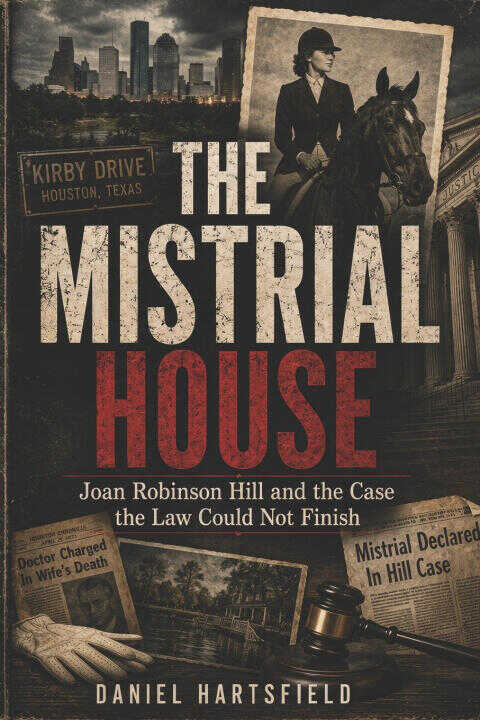
Two deaths. One mistrial. A legal record that never produced the ending Houston expected.In March 1969, Joan Robinson Hill died at thirty-eight after a sudden illness and hospitalization. The accomplished Houston equestrian left behind a young son, a grieving family, conflicting medical questions, and a death that would soon move from private tragedy into one of Texas's most unusual criminal prosecutions.The Mistrial House is a historical true crime account of Joan Robinson Hill, Dr. John Hill, and the case that tested the boundary between medical uncertainty and criminal responsibility. Rather than treating suspicion as proof, the book follows the surviving record through Joan's illness, competing medical interpretations, grand-jury proceedings, and the prosecution theory that John failed to obtain adequate medical care for his wife.John Hill was indicted and brought to trial, but the jury never delivered a verdict. The proceeding ended in a mistrial. He was neither convicted nor acquitted, and another trial remained possible. Then, before the state could try him again, John was shot and killed at his Houston home.His death created a second case with a separate chain of evidence. Investigators followed the gun, testimony, telephone records, travel information, and the people later connected to the homicide. Convictions were eventually obtained against others involved in John's killing, yet broader allegations about who may have set the crime in motion remained contested. None of those proceedings could return a verdict in Joan's case or transform John's later homicide into proof of what had happened to her.At the center of the book is the distinction public memory often loses: allegation is not adjudication, sequence is not proof, and an unfinished prosecution cannot be completed by a later tragedy. Court decisions, legal filings, reported testimony, medical uncertainty, and the limits of surviving records are examined without forcing disputed evidence into a cleaner conclusion than the law produced.The narrative also restores Joan to more than the role assigned to her by scandal. Before hospitals, grand juries, and courtroom arguments overtook her name, she had built a public life through equestrian competition, family, discipline, and achievement. Her story remains the human center of a case that increasingly became about what others believed had happened to her.Written in a restrained, evidence-aware style, this true crime investigation moves through Houston society, medical controversy, an extraordinary murder-by-omission prosecution, a mistrial, a later homicide, criminal convictions, civil litigation, and decades of retelling. It is an account of what the record establishes, what remained disputed, and what could no longer be tested once the defendant in Joan's case was himself dead.For readers interested in Houston true crime, Texas crime history, courtroom nonfiction, medical mystery, and unresolved historical cases, The Mistrial House returns to the evidence without pretending that uncertainty is an answer.
▾ Mehr lesen▴ Ausblenden
Zum Tausch verfuegbar
0Niemand bietet diesen Tausch gerade an.
Benachrichtigen, wenn verfügbarBewertungen
Bu kitaba henüz yorum yapılmamış. İlk yorumu sen yaz.