
Devam etmek için giriş yapın — işleminiz tamamlanacak. Hesabınız yok mu? Kaydolun
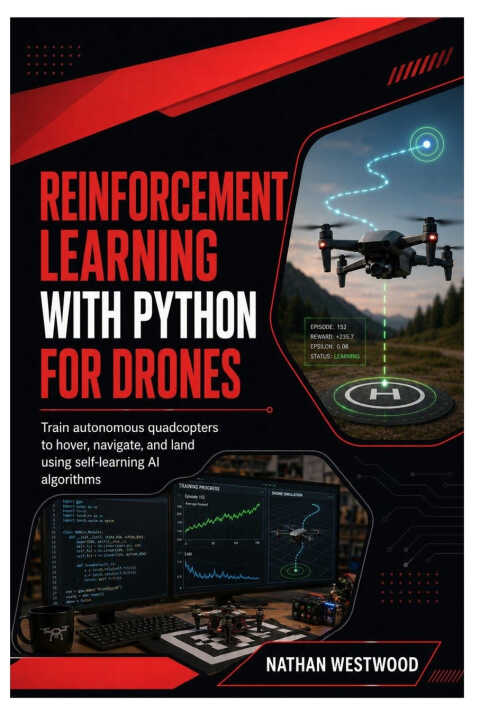
Reinforcement Learning with Python for Drones
Açıklama İngilizce dilinde
Teach a simulated quadcopter to hover, navigate, avoid obstacles, and land through repeated practice.A quadcopter is easy to admire but difficult to control. Every motor change affects altitude, tilt, speed, direction, and stability. Wind, sensor noise, changing weight, and timing errors make the problem even harder.Reinforcement Learning with Python for Drones shows you how to train autonomous drone behaviours in simulation before moving cautiously toward real hardware.Using Python, NumPy, Gymnasium, PyBullet, Matplotlib, and Stable-Baselines3, this beginner-friendly guide will help you:Understand how quadcopters move, hover, turn, and respond to thrustLearn the reinforcement-learning loop of observations, actions, rewards, steps, and episodesCreate a clean Python development environment for repeatable experimentsBuild a reusable simulated drone environment with Gymnasium and PyBulletDesign useful observation spaces, action spaces, reward functions, and termination rulesTrain a simple altitude-control agent with Q-learningMove from Q-tables to neural-network-based learningTrain a hovering agent with Proximal Policy Optimisation, or PPOImprove hovering under varied starting positions, sensor noise, wind, and mass changesTrain a drone to navigate toward waypointsTeach an agent to avoid static and random obstaclesBuild an autonomous landing task with alignment, descent, touchdown, and failure handlingUse domain randomisation to reduce the gap between simulation and realityEvaluate results using hovering error, navigation success, collision rates, and landing accuracyCompare DQN, PPO, and SAC for drone-control tasksSave models, organise logs, plot results, and make experiments reproducibleMove cautiously through software-in-the-loop, bench testing, manual override, emergency stop, and controlled flight preparationYou do not need previous robotics or reinforcement-learning experience. The book introduces the required Python concepts as they become necessary, including variables, functions, classes, loops, arrays, file paths, and structured project folders.The four main flight projects build on one another: hovering, waypoint navigation, obstacle avoidance, and autonomous landing. Each project is trained, tested, measured, and improved before becoming part of the next stage.Safety remains central throughout. You will not place an untested learning policy in direct control of a powered aircraft. Training begins in simulation, and later hardware transfer is treated as a staged process using conservative limits, propeller-off bench checks, flight boundaries, manual override, emergency stop, and local aviation rules.Build the learning environment, train the agent, measure the result, and develop drone-control skills one safe experiment at a time.
▾ Devamını oku▴ Daha az
Takasa Açık
0Şu an takasa açan yok.
Takasa çıkınca haber ver