
Inicie sessão para continuar — concluímos a ação por si. Não tem conta? Registe-se
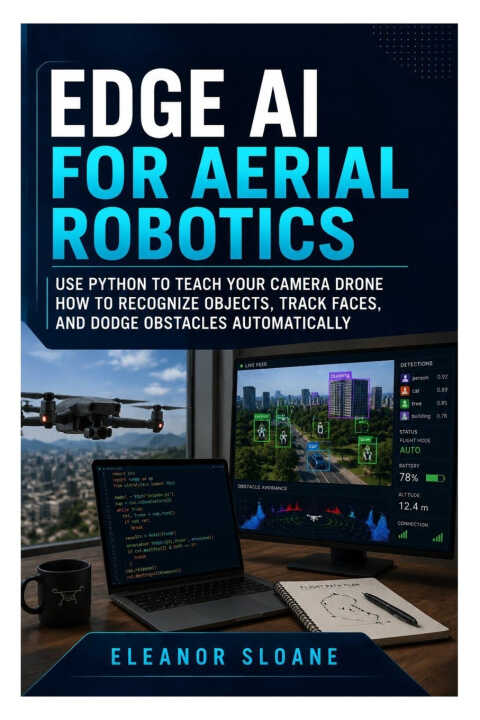
Edge AI for Aerial Robotics
Descrição em inglês
Build a Camera Drone That Can See, Follow, and React-Without Giving Vision Software Unrestricted ControlA drone camera produces images, not understanding.For an aircraft to react to what it sees, software must capture each frame, detect or track the intended target, evaluate confidence and timing, check whether movement is permitted, consider nearby obstacles, send a limited command, and confirm that the aircraft remains inside its safety boundaries.Edge AI for Aerial Robotics provides a practical guide to using Python to develop camera-based drone behaviours, including object detection, consent-based human tracking, visual target following, distance sensing, and reactive obstacle avoidance.Instead of allowing an experimental vision program to control motors directly, the book uses a layered aerial-robotics architecture. PX4 remains responsible for stabilisation, state estimation, flight modes, limits, and flight-critical safety. A Linux companion computer runs the camera pipeline, machine-learning models, tracking, behavioural logic, and application logging. Python communicates with the aircraft through MAVSDK while QGroundControl provides independent operator supervision.Inside this project-based guide, you will learn how to:Understand edge inference and why visual processing is placed near the aircraftCompare local processing with cloud-based analysisMeasure camera, inference, communication, and aircraft-response latencyReject old frames and predictions before they create unsafe movementSeparate perception, decision-making, control, and safety supervisionUnderstand the responsibilities of the flight controller and companion computerSelect a programmable flight platform for a vision projectCompare simulator-only, Raspberry Pi, and NVIDIA Jetson configurationsChoose between RGB, wide-angle, global-shutter, stereo, depth, and low-light camerasEvaluate ultrasonic, infrared, time-of-flight, depth-camera, and LiDAR sensorsAccount for payload weight, electrical power, heat, cooling, vibration, and mountingVerify software, camera-driver, model-runtime, and autopilot compatibility before purchasing hardwareCreate a maintainable Python robotics workspaceManage dependencies with an isolated virtual environmentOrganise camera, detection, tracking, control, telemetry, safety, configuration, and logging modulesStore operating limits in validated YAML or JSON filesUse asynchronous programming without blocking telemetry and watchdog processesThe book also establishes responsible limits. Face tracking is treated as temporary, consent-based following rather than face identification. The vision model cannot arm the aircraft, remove operating limits, replace failsafes, or override the operator. The system must stop, hold, land, or surrender control when tracking, sensor, communication, or boundary conditions become unsafe.Supporting resources include environment and connection commands, simulator and edge-device configuration templates, detection and control settings, safety and preflight checklists, troubleshooting matrices, emergency procedures, and a hardware-selection guide covering CPU-only systems, Raspberry Pi, Jetson, RGB cameras, global-shutter cameras, depth cameras, and LiDAR.Whether you are a Python developer, robotics student, drone enthusiast, computer-vision learner, maker, or engineer exploring onboard machine learning, this book provides an organised path from recorded footage to a supervised perception-driven aircraft system.Measure every delay. Reject uncertain observations. Limit every command. Let obstacle safety override following. Keep the pilot and autopilot in authority.
▾ Ler mais▴ Ocultar
Disponivel para Troca
0Ninguem esta oferecendo esta troca agora.
Avisar quando disponívelAvaliacoes
Bu kitaba henüz yorum yapılmamış. İlk yorumu sen yaz.